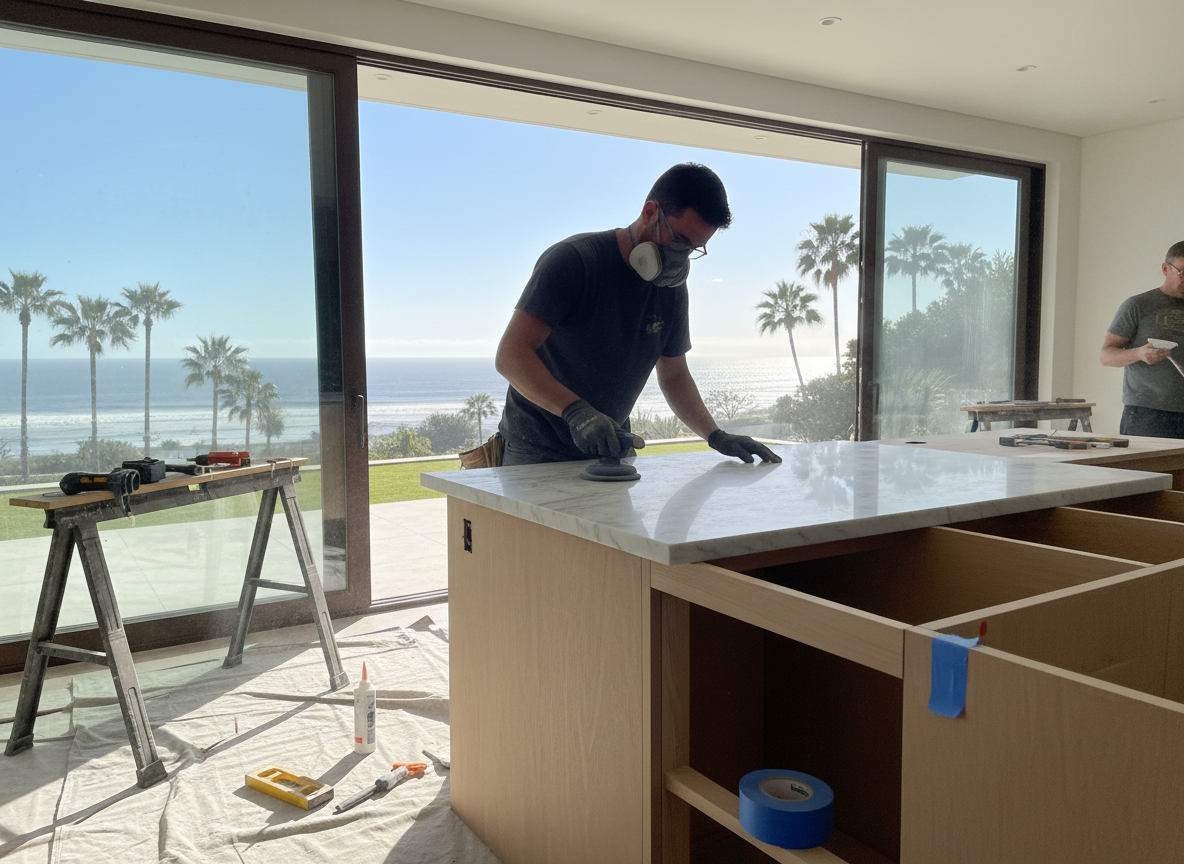
Malibu kitchens often sit in homes built from the 1960s onward along Pacific Coast Highway and in neighborhoods like Malibu Colony and Paradise Cove. Salt-laden air accelerates corrosion on metal edges and degrades certain sealants on natural stone. We select low-porosity quartz or honed granite and use marine-grade epoxy at seams so humidity swings from the ocean do not lift edges or discolor grout lines. Los Angeles County seismic requirements also mean we anchor heavy slabs to cabinets with additional blocking before final set.
Point Dume and Zuma Beach residences frequently feature open floor plans with large islands that must withstand daily foot traffic and occasional sand tracked inside. Substrate preparation includes checking for moisture intrusion from the mild but persistent coastal fog. We shim and level cabinets to within 1/16 inch so the finished surface does not telegraph waves when the sun hits at an angle. Edge profiles are chosen to shed water rather than pool, reducing long-term staining on light-colored materials.
Carbon Beach and nearby Santa Monica border properties sometimes sit on sloped lots where differential settling has already occurred. Before templating we photograph and document cabinet alignment so any future movement can be addressed without voiding material warranties. Installation crews carry portable dust containment because many jobs occur while homeowners remain in residence during the dry season when windows stay open.
Technician insight
In Malibu the thing that catches most people out with Kitchen Countertop Installation is the salt air creeping under standard sealers on stone near Zuma Beach or Point Dume; we switched to marine epoxy years ago after watching edges lift on three Colony jobs within eighteen months.
Countertop Replacement After Settling
A Point Dume kitchen showed cracked seams on existing granite. We found the island cabinets had shifted from coastal soil movement. We added blocking, re-leveled the base, and installed new quartz slabs with flexible joints. The surface stayed flat through the next winter rains.
How it works
- 1
Site Assessment
Measure existing cabinets, note exposure to ocean air, and review any settling at the address.
- 2
Material Selection
Recommend quartz or granite suited to salt air and provide samples matched to the home's lighting.
- 3
Templating And Fabrication
Create precise templates on site and send to the shop for waterjet cutting and edge finishing.
- 4
Installation And Sealing
Set slabs with seismic anchors, apply marine-grade sealer, and perform final cleanup.
Pricing
Cost depends on material choice, island size, and any leveling work required by the home's terrain.